Max
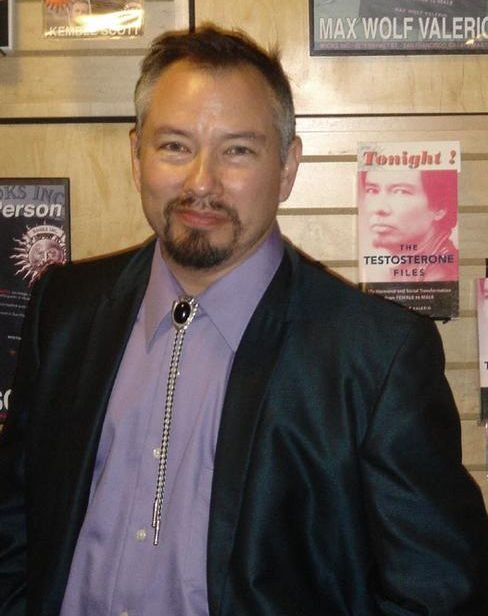
Max Wolf Valerio is a trans man, and a mixed Blackfoot/Sephardic poet, performer, and writer. He has appeared in a number of documentaries, including the Max short in Monika Treut’s Female Misbehavior. He featured in several feature films, including Unhung Heroes, in which he plays a pansexual artistic transman who dreams of exhibiting sculptures of his penis, and Gendernauts. Valerio’s writing has been published in This Bridge Called My Back (pre-transition under his former name, Anita Valerio), This Bridge We Call Home, Male Lust: Pleasure, Power, and Transformation, Transgender Care, Body Alchemy, and The Phallus Palace.
SealPress. “Max Wolf Valerio,” n.d. https://www.sealpress.com/contributor/max-wolf-valerio/.
Max Wolf Valerio is an iconoclastic poet and writer, and a long-transitioned man of transsexual history. He identifies primarily as an individual although his ancestry is Northern European, American Indian (Blackfoot Confederacy- Blood/Kainai band) on his mother's side, and his father is Hispano from Northern New Mexico and descended from the Conversos and crypto-Jews of the Sephardic diaspora following the Expulsion. A chapbook Animal Magnetism (eg press) appeared in 1984. He read and performed his poems to music and in featured readings in San Francisco throughout the 70s and 80s at places like Intersection for the Arts, CoLab, Valencia Tool and Die, the San Francisco Art Institute, and The Marshall Weber Gallery (now ATA). Recent poetry includes: Exile: Vision Quest at the Edge of Identity--a long poem set to ambient music and excerpted in Yellow Medicine Review and made possible by a Native American Arts and Cultural Traditions Grants (NAACT) from the San Francisco Arts Commission; a collaboration with photographer and painter Dana Smith, Mission Mile Trilogy +1; poems in the anthology TROUBLING THE LINE: TRANS AND GENDERQUEER POETRY AND POETICS (Nightboat Books, 2013). His memoir, The Testosterone Files (Seal Press, 2006) was a Lambda Finalist for 2006. His latest book of poetry is THE CRIMINAL: THE INVISIBILITY OF PARALLEL FORCES (EOAGH Books, 2019).
bookshop. “About,” n.d. https://bookshop.org/contributors/max-wolf-valerio.
https://maxwolfvalerio.substack.com/
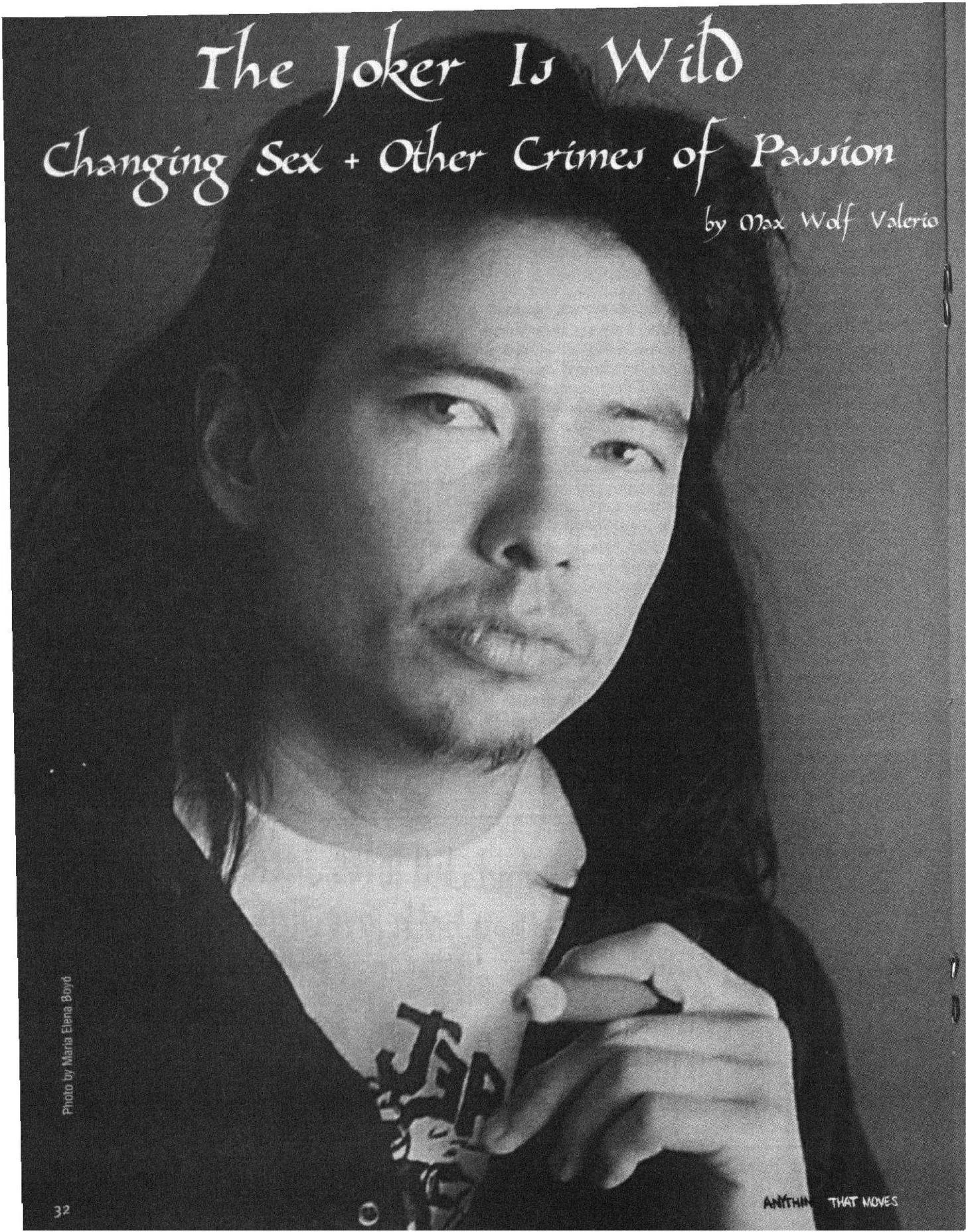
Photo by Maria Elena Boyd of Max
MAX
Jackal: [00:00:00] Hello everyone. Welcome Stealth a Transmasculine podcast. I'm Jackal. I'm Kai. We're your hosts for the Trans Masculine Podcast. The new season means new questions, and this season focuses on staying connected during these difficult times. Our show focuses on the stories of people who identify as transmasculine and who transitioned either socially or medically before or around the year 2005.
The name of our show highlights two important facts that one, for our generation. We were often told to hide our past and live in underground existence. And due to that, our stories are often overlooked. We want our audience to know that we ourselves are part of this generation of trans masculine identified people, and that we value the experiences [00:01:00] inside our trans masculine community.
We want people to know that throughout our lives, each of us has had to navigate issues of disclosure, which have impacted us In many ways, the bond we share as persons of trans experience is precious and lifesaving. These are trying times. Throughout the world, there are groups removing protections in place for our trans and non-binary communities, safety is a real concern for us, particularly our trans and non-binary bipoc siblings.
We offer links to health and safety resources on our website, trans masculine podcast.com. We also have an incredible mentor mentee buddy program that has connected 88 trans men. If you're interested in becoming a mentor, please reach out to our awesome volunteer Clark. Via the mentoring tab on our website.
Please hold each other dear and stay in touch with us. If you're new to our show, welcome and if you're a follower from a previous season, thank you for your continued support. As [00:02:00] humans, we are always changing and transitioning. As elder trans men, we assume many roles. We get married and divorced. We are caretakers, we are parents.
We are professionals, academics, and advocates. We push for human rights and systemic change. We invite our listeners to remember that we are a living community. We are healthy, we are contributing, we have experienced loss and success. We are loved, and we welcome you to our stories.
Speaker: Hey, this is Sean Aaron. He, him, his. And I'm here to tell you about them. Boys podcast. I'm the host of them boys podcast, and as a black queer trans man, the podcast amplifies the voices of other trans men of color as we share our transition stories. The podcast not only amplifies the voices of trans men of color, but it raises [00:03:00] awareness and conversations around our lived experiences.
You can listen to the podcast by going to them boys.org/podcast. That's D-E-M-B-O-I s.org/podcast. I hope to have you join us on the next episode.
Jackal: So welcome back to Stealth. Thank you for being a listener, and maybe if you celebrate Merry Christmas ish and any other winter holiday, you might be celebrating. We're here with Max. How are you doing today, max?
Max: I am doing great. I am a little tired. I just got back from Los Angeles a long trip where I went to see Leon Mavoy, self-made. Men
Photography exhibit. In West Hollywood at the One Institute. [00:04:00] So check his photography out. That's a little shout out.
Jackal: Yeah, definitely. And in my mind you're famous, max, but how did you come to be on the show?
Max: Well, a friend of mine, basically gave my name to Kai, and I met Kai years ago
in Seattle at the gender conference there, I
think in 1998 or 96. I can't remember.
But yeah, 96, a long time ago. So basically that was it.
Jackal: Cool. Thank you so much.
Kai: That's great and it's nice to see you again. I really wanna thank you for being on our show. It's been a while. I think we both are a little older now,
Max: Oh yeah.
Kai: so
Max: Doing good though. You look great.
Kai: you too. Yeah, when I met you, I was really a baby trans at the time, so it's really nice to see you.
So Max we like to hear about people's how we came in to be trans men. And one of the things that we always ask people is, how did you first learn [00:05:00] about trans masculine identities?
Max: It wasn't called trans-masculine. Then of course, because I transitioned in 1989, that's when I started my, process medically, I began exploring it in 1988. I went to my first F to M support meeting. In I think September of 1988. What happened was, of course, it was a long unraveling for me from being identified and thinking I was a lesbian because that's all I knew that anyone could be, right?
Who was like me in terms of my gender? And also in terms of my sexual preference for women. I thought I was a lesbian. And of course, earlier in my life, I've been a part of many communities, Tibetan Buddhist punk rock literary communities of various kinds. But I came out as a lesbian in the second wave in 1975. And I came out at a university and there was a lot of TERFs was basically the way we saw trans [00:06:00] people. And we didn't really talk about them much.
There was no controversy. But I think that was just a given. And I remember a girlfriend of mine at the time whispering in my ear that there was a secret she had to tell me and that one of her ex-girlfriends was dating a trans woman. Of course she didn't say trans woman, but we were both very accepting, but we realized we just had to keep this a secret. That's what I came out of and I thought, that being a lesbian would cure me of being trans,
Which is funny,
but because I thought as a feminist. I came out into the LA framework of feminism that all those feelings I'd had when I was a kid, really young kid, were because of the patriarchy poisoning my mind. And it took a long time to get over that. And of course I didn't see any alternative, I knew there were trans [00:07:00] women. Vaguely. Vaguely. But that was about it. It took a while, and I think what happened for me, there was a long unraveling of realizing maybe I'm not a lesbian, maybe this isn't right for me.
I'm different from the other lesbians. And then at some point, I remember seeing an ad in on our backs, little tiny, teeny tiny ad,
teeny little ad in the back pages. Information for the female to male, cross dresser and transsexual, and I just thought, what the hell is that? That's weird, wow. That looks like maybe I'm one of those. And it was Lou Sullivan's address, PO Box.
Said were support meetings. And so I eventually wrote him and he sent me a booklet, his little booklet information for the female to male cross dresser and transsexual.
And I read that booklet like 50, 60 times, stuck it under my bed.
Didn't tell anybody about it. It was my big secret.
[00:08:00] And, eventually called Lou
and met Lou and he was amazing. He didn't push me in any direction, but he, let me see what was possible.
Kai: Was it like for you to know that we existed as a community? That it was a possibility you remember?
Max: Oh yeah, it's a long time ago.
Kai: Yeah.
You're bringing back memories for me. What was it like, what were you feeling or what were your thoughts? You said you hid the pamphlet or the booklet and you were reading it and rereading it, and you took some time before you took next steps.
Talk to us a little bit about that.
Max: I was terrified, but I was really excited. And when I got the newsletter in the mail, I
saw Rupert Raj's photograph, little tiny photograph. Not even a very good quality
one that was, it was all like mimeographed anyway, it wasn't the high quality printing, it Lou could do at the time. And I just thought, oh my God, he looks like a man.
Kai: Yeah. Yeah.
Max: And that's really, I think the truth [00:09:00] is, that's all I needed to see.
Kai: Huh?
Max: Because it was like, I didn't think it was possible. I just thought, I may as well be a butch lesbian. And at the time, of course, butch lesbians were out. Butch and femme was out and separatism was in, and the big controversy was whether or not you were gonna be a separatist and whether or not you would even allow yourself to listen to the Rolling Stones or read books by men.
Jackal: That's hilarious.
Kai: Yeah. You brought up TERFs, during second wave feminism, and one of the things I remember is, androgyny and no, no butch femme, no extreme ends of the continuum. And I don't even remember us being part of the conversation until we heard about the Michigan Music Women's Festival and excluding trans women, but I think we weren't really on the radar, it's interesting you're bringing this back and so you connected with Lou, and then you gave him a ring and what happened next?
Max: I gave him a ring. He had a male voice. He was just very kind and [00:10:00] open. And he told me he was a gay man, and that was another layer. I was just like, oh my God, wow. That's amazing.
That that floored me. Because again, I was just hearing about this for the first time, stuff that we just see as a given.
And he said, you can be anything you want. And to me it was like this wonderful magical portal I was entering, where, you know, anything was possible. And, it was really about openness. I just felt on his end this sort of openness and that he had done this incredible thing.
It was magical to me. And it's such a contrast by the way, with the way things are now, the way this is portrayed now. And then I met him. And again he was very masculine looking and he was just a very down to earth guy. He was from Wisconsin originally.
We were in San Francisco.
And he said, he saw potential in me that you could do this. But he also was like, you may not wanna do this, and that's cool too. Just check this, he knew I was checking it out, but the truth was, again, even though I went [00:11:00] back and forth in my mind, and I struggled with it because it was daunting in 1988. To tell people that you wanted to transition, particularly my lesbian friends, but I also had a poetry community and I was giving readings which is something a lot of trans men don't know about me. But I had been a, I don't know. I had been a poet known as a poet and giving readings at places like the Art Institute or the intersection for the arts and originally when I was 18 or so in, in Colorado, where I went to university at, in women's coffee houses.
But then I got into the literary world, which was not identified with sexuality. It was just about writing, which is how things were back then.
You weren't identified with any particular group. You just went out and you read your stuff. And I also got in the punk world, so I wasn't worried as much about those people, though I did quit reading out. I did quit. I thought, I don't know how I'm gonna introduce. So I guess I was worried actually, I [00:12:00] thought, how am I gonna introduce myself back to my audience? 'Cause I'm doing a sex change. That's how I thought of it. We didn't say transition we didn't have the word gender in use the way you have now. So it was very daunting. How would I tell my lesbian friends, even though a lot of them weren't very good lesbians at that point. Most of them at that point weren't as much second wave. They were maybe ex second waves, and they were a lot of punk lesbians who back then, punk lesbians were basically considered persona non grata. At dyke bars, right? Believe it or not, people are shocked, you walked into Amelia's punked out and everybody would just stop talking and stare at you,
Jackal: wow. So you were my foremother father because I was totally a riot girl and punk rock from the get go. And yeah I walked into a bar and I don't even know if I noticed that. Everybody stopped talking. I was just like, fuck you. I'm here. I'm here. But it's the way I think about people who have like pink and green and blue hair [00:13:00] today. I'm like, you are able to do this in the community college because I did it and got a lot of shit for it. Okay.
Anyways, it's interesting.
Max: Yeah. Yeah. Back then you'd walk down the street, and this is in San Francisco in the eighties, and people throw things outta cars.
Jackal: yeah. Oh yeah. Totally. Totally.
Max: But it was a measure of your success, if I can, it was really a very confrontational kind of,
Jackal: Yeah.
Max: Thing to do.
And you were successful if you were freaking people out.
Yeah.
Jackal: Yeah,
Max: There was no such thing as a safe space,
Jackal: yeah, totally.
Max: but but,
Yeah.
Jackal, you're right.
I saw it happening in the nineties and by then I wasn't a dyke anymore and all of a sudden there were all these punk dykes, right. I was like, damn it. Now I'm a man.
Jackal: Yeah.
Max: But I did go to some of the gatherings, I did go to some of the the bars I guess those female Trouble and muff dive. But I felt really, like I'm the guy watching the dikes.
Though, I had a few friends, but
Right.
Jackal: It's interesting because I was the director of a lesbian community. Now [00:14:00] when I talk about it, I tell people that I was the director of an L-G-B-T community center, but actually it was the Vancouver Lesbian Center. And when you talk about this, the second wave and things like that, it just totally reminds me, 'cause you said on your backs was when the magazine that had the blurb from Lou Sullivan, but that was after the Off Your Backs magazine. That was the original, which was that hardcore separatist, and on your backs was the sex positive?
What do you call it? Call back to, that, that magazine off your back. So it's really interesting that you bring up all these memories for me too. What was your actual transition like? We talk about the Harry Benjamin standards and things like that. Walk us through the process.
What did you do?
Max: I went off the beaten path at the time, I was working at the time but my mind was blown. I was just really overwhelmed and I realized I had to be really strategic and only tell certain people, what I was doing. [00:15:00] At that point, I knew the hormones would change me pretty quickly. I knew testosterone was very powerful, but so I knew I didn't have forever to tell people. My parents were living here in Colorado and my nuclear family and then being native, of course, there's the people on the reserve where my mother grew up in Alberta so it was very daunting, but what was your question?
Jackal: Your steps. First of all, okay. Let's just stay here for a minute because one of our questions is how do you think your social standings, your race, your class ability, sexuality, the community that you're part of, impacted. Your desire or fears about transitioning? Let's go there first.
Max: Okay. That's a very interesting question actually, because I think, for me I had a good job. I didn't always have good jobs, but a decent job. And this is before the.com
so it was when San Francisco wasn't known for having fantastic jobs necessarily. We didn't have tech the way we have it now, it was beginning, but it [00:16:00] was just in the beginning. And it was always slightly expensive city, but you could actually work a regular shit job, so to speak, and have your own apartment, so it was really different back then. I'd say before 95 or 96 is when everything changed. So this is back in 89, 88.
I didn't have a lot of money though, so I think because I wasn't professional class and I was a bohemian, I was very counterculture. I was a poet. My life was really about my work, about my writing, about the poetry. And I had chosen to take the path of, being like the beats, living hand to mouth, being outside, and outside the academy for that matter. And so yeah I didn't have a lot of money, I didn't have access to, I think there was a gender clinic, the Stanford Gender Clinic, I didn't feel like I had access to anything like that, and there wasn't much. There was hardly anything. So I was definitely not somebody who felt like, okay, I can find a way into this because I'm professional class, whatever. But I figured I like everything in [00:17:00] my life, I would improvise. I was good at that. And so there was a place in San Francisco called the Center for Special Problems, and that's generally where they sent a lot of the transsexuals and the sex offenders. So that's where I originally, I can't remember how I ended up there, but I had a meeting there.
I somehow got connected to that. And I saw a shrink and I explained to him what I wanted to do and I had made up my mind. I had previously talked to a therapist back in 86, a lesbian therapist, and I had told her something to the effect of, I know this really sounds weird. This really sounds strange. But I don't think I'm really a woman. And she was stunned. And this was back in 86, I think, and she was just stunned. And then she said, I don't know why, but that sounds right for you.
Jackal: Wow.
Kai: That's pretty affirming [00:18:00] for
Max: Yeah. She was affirming even though that language wasn't even being used
in back, but we just looked at each other, but I never mentioned it again. And
she never brought it up. But she was one of those therapists that lets you
talk and say stuff, but it stuck with me. It was like, okay, this is something real. And, the affirmation helped, but I knew, this is something real, but I don't know what I wanna do about it.
And I was terrified, as I said earlier.
And also I didn't have resources. But anyway, when I discovered Lou, I discovered there was a way I went to the center for special problems and the shrink there basically said, you're gonna have to explain to me why you can't just stay a lesbian. And I was just like, that's it.
I don't wanna sit here and explain to this guy for the next six months to a year. Why I can't just stay a lesbian, right? Because I'd really made up my mind, I'd been through it in my mind I was 32 years old at the time and I felt a sense of urgency. It was just like, I've gotta do this.
I've just gotta get this done. And most of the guys [00:19:00] back then were probably in their thirties, I think early thirties. It was unusual. You didn't really meet people in their early twenties who were doing this,
Jackal: there were some, but yeah.
Max: It was different, and of course there are people even a little older.
So in any case I wanted another way and I saw another ad, and it was for Gianna Israel.
And she was a trans woman and she was really a character. She had never graduated from high school, but she was self-taught and she actually ended up writing a book with Dr. Tarver, I think is his name about it, was called Transgender Care, which got a lot of mileage in the nineties.
I think she's deceased now. Unfortunately she died of AIDS in 2006. But she was being supervised by the Center for Special problems and, so she, knew her stuff. There were little gaps in there, I think in terms of her clinical approach.
But she knew her stuff and so I talked to her on the [00:20:00] phone and she said, come on in. It was sliding scale. It was like 15 bucks an hour. Perfect. Even though I was working, but then I lost the job because I was so preoccupied with this whole thing that I was spaced outta my mind. And also I wanted to be punked out at my job. And back then you couldn't do that, right? I had to wear more feminine clothing, which I hated it. My feminine clothing was a cable knit sweater and women's pants, which I looked terrible in.
But anyway so I went to see Gianna, I think she was calling herself Joanie Israel at the time. And we started talking and I had three months of therapy and then we continued for a while, but three months till I got my testosterone, my letter. Okay. And I had the letter first for my name. I went in and got my name change on the, which was easy to do in California at the time, at the DMV. And then I got it changed to male
So it was pretty easy though nobody had heard about this thing,
Jackal: hey, so our show is called Stealth. And we always ask, what does stealth mean to [00:21:00] you?
Max: Good question. I don't really think of myself as stealth, but I like the word. Because it distinguishes itself from, the LGBT the gay thing of being out, because I think being out as trans is different from being out as gay
Jackal: I totally do too.
Max: And it's really easy to confuse the two. I think most people do, but of course when we come out, when we give up, being stealth, or when we disclose is the word, I
Jackal: Yeah.
Max: When we disclose the fear is that we will lose our identity and when gay people come out, their identity is reinforced or revealed.
Jackal: Yep. Yeah. There's somebody who, who said it on our show. I'm not coming out because this is always who I've been. I'm letting you in to who I am. So it's a big difference and I really do appreciate that kind of difference between L-G-B and the T kind of thing.
But [00:22:00] back in the day, were you told to live a stealth lifestyle?
Max: Gianna was really open and I don't remember her telling me any of that, so I was definitely in a new lane without realizing it. I knew that I didn't wanna do all those weird things. I was aware that. My God, I think there were still people around where you had to go a year maybe, which isn't so onerous, with therapy. But I didn't wanna go that long necessarily, even though I could have, but it was, yeah I did know that some people had to not tell anybody. And I had heard that they were encouraged to get a divorce and make new friends and that kind of thing.
That was a little before my time when I think when that was really at its apex because the support group I was in included people like James Green and the late Lauren Cameron, and then there were these guys, who knows where they went, you know, but they were actually further along than we were in transition. And some of them might have had stories like that. But [00:23:00] mostly it was like a new day. I felt like Lou Sullivan was ushering in something new and we weren't sure what it was yet, but Gianna was kind of part of
She did tell me, it was time. I was still doing some drugs here and there, punk rock not a ton, I was still at that point doing a little bit of recreational drugs and she basically was like that's over. That has to be over, and it's like the time has come, to clean up your act because you had to put your best foot forward. For your health and everything else. So there was a demarcation in my mind, but yeah, I'm lucky I didn't do any of that stuff that really honors that weird stuff.
Jackal: Yeah.
Kai: Yeah.
And I think Seattle was behind San Francisco about 10, 15 years or so because there was still lingering you know, reconfigure your past, everything. And I remember the psychologist who I met with, who saw me initially was saying, yeah, something along those lines. And thinking about, we met some people through Ingersol [00:24:00] who were very underground and very low to no disclosing, very stealth, who wouldn't tell people. And that was just such a different. Experience, and I remember meeting in 96, the guys from San Francisco, yourself included, who were representing more queerness and more fluidity in terms of gender presentation and sexual orientation.
It was great, but we were definitely behind
Max: Yeah.
Kai: And when we think about present day. You transitioned a long time ago. And so did we, and now we're in this political climate where transgender folks are under assault and essentially many of us are really afraid and many of us are living underground a little bit.
And going back, to being lower disclosing, how do you manage that? 'cause you've been a public figure. For decades, max, and you've been like the face of our community in so many ways. Like how do you manage it now? Like when it comes up what's it like for you now?
Max: That's a good question. I think we're all in shock
that things have gotten this [00:25:00] bad. I was thinking there could be a backlash, because that's the way things tend to work. And I knew that, I had a feeling, but I still did not anticipate anything this bad and we're being scapegoated by the Trump administration
I see it as a combination of the TERFs and the social conservatives and religious conservatives. It's kinda the TERF's wet dream that this has happened. And I think it's more the TERFs in the uk when I've gone on X I did a lot of research, unfortunately into what was going on and taking it really seriously around 2021. 'Cause I realized, okay, this isn't just a few crazy people talking about us on the internet. This sounds like it's dangerous,
but I'm working up to your question. For me, there's no going back. Because I've got a Wikipedia page, people can Google me. I've had situations, I don't think of myself as stealth, but yeah, I don't disclose to everybody.
There have been trans people I've known who tell everybody but that would be nutty.
There are things people don't know about me. It's not just this, they don't know that I'm part Native [00:26:00] American. Not everybody can tell because I am pretty fair. People who have been around Plains Indians can often tell, but not always. And so there's that.
They don't know that my father's Hispanic, they don't know. There's a lot of things they don't know about
They don't know. I write poetry, seriously. God help me. They don't know. There's a lot of things and you don't necessarily tell everybody that I'm an Army brat
I was born in Germany, whatever. You don't tell people a lot of things about yourself, but it is important, right? It not small thing. I went back to school. I didn't finish my degree at CU Boulder in the seventies. I left in 77 and I went with two years under my belt and I went to to San Francisco and stayed there. I went to New college in the interim and there were other things
but anyway, I went back. What happened? I'm trying to say I went back recently because I'm back in Colorado. I went back, moved back to Boulder, and I moved in with some guys, just some straight cis guys [00:27:00] who were, one of 'em was in ROTC. The other guy is studying biology and super nice guys, and I didn't tell him. I ended up telling one of them when he was leaving because the thing for me is I say, I'm a writer. And then they say what have you written? Have you, are you published? And I'm like, yeah, I've got a memoir. What's it about?
And I'm rambling. I
Kai: What's it about? No, you're great. We're faced with so many opportunities to disclose or not disclose, and it's a very private thing.
You're also talking about using judgment, about sizing people up and reading the room and then this political climate just in the world. And I think our safety is paramount and one of the things that we really talk about and acknowledge is the importance of our connection to one another and this special bond that trans men have with each other.
Men with trans experience. How connected are you with other trans men and other trans guys?
Max: I am living in Colorado now in the Denver metro area. I know one guy from California who moved out here and he knows some people, but [00:28:00] I really don't know anybody.
And of course I knew a ton of guys in San Francisco. And but I've always had, I've been a weird person in that I've always had cis straight male friends. There were one a few gay men. I've probably had more cis straight friends than gay men friends, but I've had very important gay male friends. And I've had cis gay male and I've had, lots of women, friends trans women and cis and, so I've had a variety of friends who aren't LGBT and people from the literary world, from the Buddhist world I'm involved a little bit. I'm involved with Kumi, I've been involved in a lot of different world. The Society for Crypto Judaic Studies, I was very involved with them for a long time and nobody knew there until recently, and I loved it, in a way because I didn't wanna talk. Part of it was I just didn't want to talk about it. 'cause
you get all the questions right.
You get all these questions and, not that it's, God knows I sometimes even enjoy talking about it.
It's okay, but like [00:29:00] with the Society for Crypto Judaic studies, we were focusing on crypto Judaism, which is secret Judaism as it's practiced all over the world after the expulsion from Spain. And so I was really interested in that. I wanted to spend my time talking to people about that I didn't wanna talk about. Yeah. And then I started testosterone, whatever, I wanted to talk about that.
Kai: How did it come up? Like how did you end up disclosing to them? Because you're like, sometimes you're not there. It's not the place for it. It's not why you're there. But how did that end up happening?
Max: Gosh. How did that happen? I was talking about genealogy in general, I think. What, and I had some really good friends and they had known me at that point for maybe 15 years.
And they'd known me in person, we'd gone to conferences together and everything else. And gosh, what was that?
I'm trying to remember. At some point, I think again, it had to do with the writing. And the fact that I've got the memoir, the testosterone files that came out in [00:30:00] 2006, and they knew I was a writer before them, but I didn't tell them really what I wrote about. But I said I was a poet, and so really at some point I think it had to do with that and telling them, about the writing. And, because I am, like most writers, I'm really happy and proud. I published a book and you wanna share it with people. And so I trusted them enough to be like, why not?
But you're right. You do have to size people up now. This is all pre-Trump pre reactionary. Because now I don't know. I think there is a feeling of danger now. There is a feeling of, do I want my neighbor who's a Trump guy to know, he has concealed carry.
You have that in Colorado. He seems like a really nice guy, but you just don't know.
He's got Trump flags. Things have gotten so weird, but I know there's no going back. I've
got, 14 movies, maybe
Kai: yeah. Can you, how about we just take a moment and can you share some of the writing, whatever you're comfortable sharing, like how can [00:31:00] people find you or what are some of the things that you've written or movies that you've been in?
Max: Of course I love to share it, and as I said, there's no going back
It's important that people see writers, it is important that we have positive images out there,
especially now. That's why I think this podcast you guys are doing is so important. Because I would assume it's mainly positive. Being trans isn't a cakewalk,
Kai: Yeah.
Max: I think one of the hardest things for me, this is a bit of an aside, but one of the hardest things for me right now is seeing how this is framed as this horrible, negative thing is terribly negative, ugly
mutilation
Kai: yeah.
Max: And for me it was this amazing miracle.
This wonderful miracle
and and it was, a source of joy.
And freedom and all those things. And
so I've been stunned looking at, spending time on X and researching TERFs and GC gender critical anti-trans people and what they say.
And I'm always stunned by their [00:32:00] horribly negative perspectives. Sometimes I've gotta laugh. I'm like, my God. First of all, you don't know any trans people, obviously. One person or, maybe you've heard Buck Angel say something, I don't know. Or you've heard somebody who's anti-trans or even one of our own, who unfortunately says things that are sometimes anti-trans but really, we're ordinary people. We're wonderful people, we're just people, so some of us are fucked up but we're not all like ready to kill, because we're taking testosterone. But anyway, here's the book. Testosterone files
and Kyle Zimmerman did this photo.
Kai: Oh, for real.
Max: Yeah. And I've also written like I say, I'm a poet, and so the poetry really doesn't have much to do with being trans. I don't write that type of poetry generally where I write about my feelings or I'm expressing myself in quite that way.
But this is the criminal, the invisibility of parallel forces. It was put out by EO Press in New York City, a trans woman's press, and she's very [00:33:00] active in the avant-garde. An innovative poetry, experimental poetry scene. It's surrealistic innovative. Weird industrial, punk non-narrative poetry generally. And a lot of the stuff was written in the eighties and nineties.
So some, a lot of it's pre-transition. And i've got some more books coming up, and then there's animal magnetism, which came is a poetry chapbook that came out in 1983 under my old name. very small, if you can find that's really hard to find. But and then I've been in this bridge called my back. I was in this bridge called my back famously which was interesting. And I've written forwards to different things and so on, and I've had essays in different things. But so far that's it. We're getting more together. I've working on a novel too.
Kai: Wow, thank you. And I just wanna say one thing before jackal you jump on. I just, I, you were in, you don't know Dick and you were in the documentary called Max, I think it [00:34:00] was, and that those were shown publicly in Seattle. And you were such an important presence and part of, somebody that I looked, up to.
And your representation is so important. I wanna thank you for being so present and public.
Max: You're welcome.
Kai: yeah, and I just really appreciate that and I think the guts that it took to be that person that, you know, like along, as present as you were in public, I think is so important.
And it's important now too, and I think it, it's different. Like the safety that you're talking about now is different, but I just really want to thank you for that and comment on how important and. Specialist me to talk with you and have you on our show today.
Max: Thank You.
Kai: Yeah,
Max: i'm a little guileless, so I was always gonna open. Hey, this is great. I gotta tell everybody
Kai: yeah.
Max: Can I mention a couple of other films I think I should mention Genderation, the newer films
Genderation which is the newest Monica Troy film with myself, Annie Sprinkle, Sandy Stone's [00:35:00] amazing. And Stafford featured and it's a a revisitation of gender knots, which came out in the nineties.
Also, Monica Troy directed that and also, framing Agnes, of course. And then my friend Ray Raya has a movie called Augmented, which is a short, where he discusses transhumanism. I just talk, but we talk about transhumanism and Transsexuality and actually some of the people who are arguing against us because they think we're like, transhumanists and,
so it's, yeah, it's
Kai: Thank you. Thank you.
very much.
Thank you, max.
Jackal: So Max with the political climate and everything that we're going through, it's really important to highlight the people that support us now. So who in your life do you have that supports you now?
Max: I think at least most of my friends, most of the time I think TERF ideology. [00:36:00] Since it's come back in such a big way online has unfortunately come into the minds of some people I know and I can tell. That's really unfortunate. There's so much negativity out there right now. In a way I'm answering your question in a weird way, but, there's so much negativity out there.
But I would say my parents do their best. I think they're doing pretty good considering they're in their nineties.
And they're conservatives in a lot of ways. I have so many friends who are wonderful and most of my friends were really great. And even the ones who are a little TERFy now or most of them are hanging in there and we're working it through. But, yeah I just think, the people at the Society for Crypto Judaic studies were wonderful. The people I disclosed to, I think generally have been great. They're shocked.
I think a lot of trans men have this. I know there are some trans women who have this experience, but, usually they're shocked and they're like, you gotta be kidding me.
[00:37:00] Really? I'm like no. And that doesn't make sense. You gotta be kidding. And so once they get over that and they realize you're not just pulling their leg.
They've been very supportive, but then we're in a different time, I haven't really disclosed to too many people recently,
Jackal: What tips might you have for allies or people who love us, in the world today? As as they go through and hear transphobic stuff what they can do to better support us,
Max: I'd like to say one more thing that the people on the reserve, my relatives on the reserve have been great too, and so I didn't know necessarily, not every Native American thinks that we're shamans
That's a little silly actually, in my opinion, whatever. But yeah.
But they've been really good. What was that now what
Jackal: What tips do you have for our allies and people who love us?
Max: To continue supporting us, you mean?
Jackal: Yeah. To continue supporting us, how to respond to transphobic commentaries when we're not in the room.
Max: [00:38:00] That's a very good question. I think, right now, times are getting so scary that, some people may not wanna say much of anything because, my God Trump is about to declare people who even align themselves with us as terrorists. It's possible. I would look at where are you? They would have to do what we do. Like where am I? Am I at work? I don't wanna cause a big argue. I don't wanna, like if the boss is saying this I don't necessarily have to say anything. They've gotta think and nowadays we're living in economically uncertain times.
I don't think people have to martyr themselves for us. I'm not a purist that way.
I've never been a purist. I think one of the flaws, in our movement, so to speak, has been, there's been a lot of, purity and people demanding a lot from other people. And things don't really work that way.
People have their own processes. So I'd say, look at your environment. Is it safe? Do you think you can make an impact? And then of course, [00:39:00] also personalize it, make us real as people. Like I know this guy and even if they say something that some people might think is politically incorrect I never would've guessed. He seems like a real guy. Even something like that, using the incorrect language. Don't worry about that. Think about who you're talking to. And to me he is a real guy because, he seems so natural and so authentic and he's somebody I admire and care about.
So I think, yeah. Know who you're talking to. If they're in those milus, they're part of it, but also you don't have to Marty yourself find the right time. It's about timing.
Jackal: Yeah. Is there any question that you think we should have asked that we didn't? Any famous last words of wisdom?
Max: Yeah. Gosh. I don't know. We're in such a terrifying and scary time. I would just advise people, we're gonna come out of it, it is [00:40:00] probably gonna get worse, but we're gonna come out of it on the other side. We've been through bad things before. We've come such a long ways. Even in the time that I've transitioned those 36 years. As we've discussed here, we've come such a long ways, they're not gonna be able to take it all back. They're trying, but no way. They're not gonna be able to take it all back. And so we will triumph, but I think we are, we're looking at some hard times, so steal yourselves, but we will get through this and always know that.
Jackal: Thank you so much, max. It's been a real joy to have you on our show. It was lovely talking to you. You're amazing.
Max: Oh, thank you and thank you for doing this show. It's very important.
Kai: you, max.
Max: I would also point people to resources, your friends, to give them arguments. I know the things they're hearing about. Give them good comebacks. Give them arguments. Give them facts. They may personalize it to you, but you don't want them to say I know the good [00:41:00] one. Give them things that will support them. Have them watch movies. Have them watch movies about trans kids. All those things, have them read my book.
It's a very positive, not to beat my own drum, but it's a positive. Have them see these things that are positive and joyful and funny, have a sense of humor, right? You gotta have a sense of humor, people,
Kai: Definitely. Thank you. Thank you so much, max.
so Jackal, we just interviewed Max. What are your thoughts about our interview with Max?
Jackal: It's like I've known the name forever and of course, you don't know Dick. Wait, right? Yeah. You don't know Dick. I'm getting it confused with you don't know Jack. You don't know Dick. Very, it's different. It was actually a video game back in the day. Anyway, that's not relevant.
Very famous, like probably one of the first, if not the first trans mask movie I ever saw. And I think Marty was the one who mentioned it in his [00:42:00] interview about the first time seeing trans joy expressed. Which was really empowering. So that was amazing. And so to meet him and having him be close to me, geographically, like I'm always jealous, right?
We have all these guys in the Pacific Northwest, and you're like, yeah, come on over. And I'm like. Just shut up. You guys rub it in my face.
Kai: I know.
Jackal: Now it's having him, like I said at Camp Lost Boys, I did meet some guys in the Colorado area and stuff and really hope to connect with them as well.
I just bought a car
Kai: Oh, congrats. Yeah.
Jackal: But now I'm more mobile. So being able to connect with him and actually connect with somebody from an older generation, like 10 years older than me, or 10 years in his process at least is very exciting. And his use of language and he's an artistic storyteller, so in his interview, I think that really came out.
What about you?
Kai: Yeah, [00:43:00] for sure. Yeah, I love what a nerdy language guy and like just his roots and his appreciation for the arts and the different. Types of poetry and writing and the people who influenced him. It's a mishmash. And I really appreciated that. And coming from the Bay Area myself and having, family in San Francisco up until recently, he was talking about bars I've been to and places I've been to and restaurants I've been to, and Amelia's is a complete blast from her past.
That was one of the only lesbian bars around. And how he met Lou Sullivan, his discovering trans men. That story was great because Lou is like a larger than life figure in my mind, right?
Jackal: Yeah.
Kai: didn't know him like people. Jason knew him. Max knew him.
James knew him, Mike knew him. Yeah, but it's just to get a feel of who he was having Max, describe how open he was and how he was saying how freeing transition could be if it's your thing. That just was so [00:44:00] beautiful and I think that wasn't where I remember hearing for us.
Does that sound weird?
Jackal: On the one hand, yes. Like I think the way he described Lou Sullivan again, like little ping of jealousy, right? It was like, oh, if only I had met this larger living life, but really small, humble guy, right? Who changed? Fundamentally so many things for us, namely that straight gay dichotomy within the, you are able to transition or not dialogue, right?
And who we are as people. But I came out in Spectrum. I came out in a group that was a very supportive group. So I didn't, I don't, on the one hand. I think I did get the traditional therapy aspect of you should go [00:45:00] stealth and change your story a little bit here and there.
But I also feel like in the spectrum group that we were in, there was a lot more acceptance of. Claiming trans pride or FTM pride or not having to be invisible which I did think was more empowering, although it's really, it's a mix. Kai? Because I think we I'll say I also had more, I did have a little bit more fear back then, right?
So part of it is hard to be seen as a man, and so not wanting people to associate you with the before. And then part of it is the safety aspect of, I don't wanna be seen as a before. I only want you to see me as what's now. So making that path, [00:46:00] putting.
Self parameters on me to say, I don't want you to know this past I know, it's weird the way transition happened for me and what stealth and disclosure meant for me back in the day, back in the nineties as opposed to now. I don't know if that makes any sense whatsoever.
Kai: We transitioned in the city in which we lived and we were staying in that city, right? So I think, when I think about the concerns I had about my safety, it wasn't from people external to our community per se. It was more, are people going to recognize me?
From before I transition, whereas I'm in that sort of ambiguous looking place, and they're gonna find me out, and I think that was one of the things that I felt embarrassed about or worried about. 'Cause people literally did point and laugh or say, like some of the people that I'd [00:47:00] known for years, and that was really not comfortable.
So I distanced myself from that. The fear was a little different. Than today. But I think, like there was hopefulness because I think the group, you're talking about spectrum, there were, we were just queerish and we didn't have to, we were more, I think in that way we could just be who we were and be attracted to who we were and like express ourselves in a more fuller way than maybe another group where it was very heterosexual and a heteronormative kind of existence.
Jackal: Because I think that, talking about Seattle Ingersoll Clinic was very much more that,
Kai: Yeah, exactly. Yeah, exactly. Yeah. And then one more thing just about Max's interview. We were talking about the question, how would you. Tell allies or what suggestion do you have for allies who support us and love us? And he was, really conscientious about their own safe, personal safety and psychological safety.
And one of the things that I've been talking about in general here with [00:48:00] friends is, there's so much shock and awe and people who aren't from marginalized communities that have had the privilege, because of their positionality, all the intersection, they haven't had to worry.
About being target targets, and so I think, the fact that, people who are white, middle class, straight Christian people are losing healthcare, and they're shocked and angered, I'm sorry that people are losing their healthcare.
And I think that, like how. If you haven't been a Target, you can't really know how to talk about your experience in a way that is, like you just don't have the tread wear. Like you haven't had to deal with that hardship and how to live in a world, right?
You don't have to, you don't have to know how to express what it is to be the target or to experience oppression in the same way that other people have, that have. And so I, I think in some ways it could help us because the more outrage against [00:49:00] tyranny the better.
But I think, that was a really interesting, we've talked about my friends or family members who say, how can I support your community? How, what responses can I provide? And I liked how he was saying first check the room and make sure you maintain your own safety.
Jackal: Yeah. Yeah, thank you. It reminds me of that age old I don't know, phrase or poem kind of thing. First they came for the communist , and I was not a communist, so I did not speak out. Then they came for the Jews and I was not a Jews, so I did not speak out. And then they came for me and there was nobody left to speak out.
What you're talking about is just that, right? Because, if I don't know how to speak out for people who aren't me when there's only me left and they come for me and they're coming for all of us, like healthcare impacts everybody. It really is important to, to figure it out and develop the language.
So yeah. I can really, I feel that in my heart and soul. So [00:50:00] anyway, I really appreciate you getting Max for us making that connection. Hearing him talk
Kai: The Center for Special Problems.
Jackal: the center,
Kai: like
Jackal: that was hilarious.
Kai: yeah. That clinic. And then I and I do think it's like. He said, we're in the same clinic where they treat sex offenders and it's oh, like that. We're not a special problem. We're special flowers.
Jackal: I love that. But the thing that really threw me back was the magazine on our
Kai: Oh
Jackal: You talked about androgyny, the second wave of feminism, the second wave of lesbianism, whereas if people don't know this is really interesting. But like the second wave of lesbianism was a political positionality, basically.
And you didn't have to wanna have sex with women in order to call yourself a lesbian. You just needed to be a separatist basically. And the book that came out, the [00:51:00] magazine that came out around this was called Off Our Backs, right? We're standing up for women's empowerment. And it was very anti-sex.
It was super anti-sex and took out all of the sexuality, women's sexuality and women's empowerment around sexuality. And so the magazine on our back was a direct. rebuttal to off our backs. And then, like having Lou Sullivan be in that I didn't even know that. And that's pretty amazing.
Kai: The thing that I, Max's essence gave me was this freedom of expression and freedom of being. And I think that just feels so good because when I hear about like TERFs and I hear about, nationalists and just how much shrinkage happens and who you let into your world, or who you think should be in the world.
And I really appreciate the expansiveness. So let's hear for that. So thank you to Max for bringing trans joy today. So thank Thanks, Jackal. Nice job today.
Jackal: Nice [00:52:00] to you..
And now it's time for adventures and disclosure with Kai and Jackal.
Kai: Jackal you are. Hey Jackal, I hear you have a disclosure story for us this week. What do you got for us?
Jackal: I do, Kai, I do. And and I have to go back to the, I really hate introduction pronouns, like still after all these years, and I've really evolved I have evolved, but I just started a new PhD program. Actually, I, my first class was the day before I flew out for Camp Lost Boys. So first day of class introductions, right?
And professor says, all we need for you to do is say your name and your pronouns, right? And [00:53:00] I'm looking around this fucking room and I'm like, everybody in here is cisgendered. Everybody in here is cisgendered. And I don't know that there's anybody in here who's even queer. Like it looks like most people are straight cisgendered.
I. I was so mad. I was so mad, and I was just like, how am I gonna handle this? You know the message what are you gonna do? In this situation, it's not like I'm coming out so that, the kids in the room can be more comfortable or anything like that, it's like, what the fuck?
Kai: What are you mad about?
Jackal: That. I so it always goes back to the two paths that I feel like I have in front of me. One is that I say he him, which is how I identify, and you totally don't see me and I erase 30 years of my history in that moment or I. Come [00:54:00] out and in a two second decision in a situation where I don't know if I'm safe, right?
Those are the thing that really bothers me,
So what I did, and I think, it was, it felt better. And in the moment I was probably about halfway through like the circle, right? Everybody saying dah. He, him, she heard Da dah. Nobody said, they nobody. And it comes to me and I said, hi, my name's Jackal.
I identify as he him, but I do not identify as cisgender.
That I left it open. I don't know, people might not know what that means or what that, whatever, but I was really clear I'm not gonna say I'm trans to you, but I am going to tell you that I do not identify as cisgender.
So that, that is really clear. So that's how I handled. We broke out into small groups afterwards, and I was still carrying that with me in the first group. And the professors who were leading our small group or whatever, like again, said they're names [00:55:00] and their pronouns and they're so proud that they're saying their pronouns.
And I said, look, like I. Identify as he him, but I am trans and this is a really uncomfortable situation for me because you're putting me in a situation where I either have to say he, him and I erase 30 years of my life, or I come out in a situation where I don't know that I'm safe. And so just to be clear, that's what's happening here.
Kai: What do you think they need? Like how can, how would you explain to somebody who didn't understand what you meant, like what it means to erase 30 years of your life if you said, my pronouns are he, him, and you didn't disclose anything else, I.
Jackal: yeah. I had an afab, how do we call it? Female socialization in my life, right? So there's a lot of history there that is part of who I am, like a major part of who I'm right. And, however they relate to female [00:56:00] socialization or, being born female.
That is an important part that I don't want people to just ignore and erase and say, and I don't wanna perpetuate my own invisibility. That's really important to me. I don't want to do that to me or the, she, I was, kind of thing. So that's that's what I would say to
Kai: Yeah, that, yeah, that makes sense to me. And I think, it's
Jackal: It does.
Kai: Yeah, it does. It does. And I also think, there are people who find it extremely affirming to have somebody be ask you, and they say thank you. And it's, especially if, maybe they're in a place where they, people assume things that don't line up with what, that,
Jackal: I, I totally get it. Like I said, like I, I have evolved a lot in the past, whatever, five, 10 years that this has been going on. But and in I. In the spectrum group that I lead right now with the kids at school, I will say very clearly, I identify as he, [00:57:00] him, and I am trans, and I have no problem doing that.
Like disclosing in that environment is so different than in this other situation where I really can look around the room and pretty much clock everybody who's there, like I know where. Your liberal attitude is coming from. And that may or may not be cool. You may be a pro Charlie, Kirk Trumper or whatever, or not.
And literally this is the first day of class and I have no fucking idea if I'm safe. None. And that's really hard. That's really hard because our invisibility, trans-masculine invisibility is so real and people do not know how it impacts us.
Kai: And it's generational too, right? I think people don't realize that one we exist and that we can age, and that we've been around for a while and it's just a different. A different experience. So thank you for sharing that. And I don't like, if you're thinking about I live in the liberal [00:58:00] ward zone of Portland, and with the Antifa terrorists here, it's I just think, this is such a woke area.
We're very progressive in all seriousness, we're very progressive. A lot of the organizations and folks here are very progressive and up to speed. And then if you go on, say for example, you're applying for a job, which I happen to be looking around, if you go into their online portals, there's like male or female or other, or maybe
Jackal: Are you
Kai: non-binary.
There's usually not a, trans mask or whatever. But then do I really wanna put that on an application? If they do have trans men or whatever, do I really wanna say that upfront? Because you're right. It's a really hard dis whole disclosure thing. Jeal.
Jackal: Yeah, totally. I've told you this before, but like in Colorado, they have this thing where you're supposed to say what you were assigned at birth, right? So you can put your gender and da, but they always ask, what was your [00:59:00] gender assigned at birth? I'm not gonna answer that. Que I'm sorry.
Like all my documentation says male prove me wrong. you. I'm not I'm not safe.
Kai: Yeah, exactly.
Jackal: We're
Kai: We're faced with this stuff all the time, so thanks for sharing that.
Jackal: Thanks.
Kai: Yeah. Good job today, jackal.
Jackal: Good job to you, Kai. We want to thank our listeners and especially our guests. This show would be nothing without our guests who share their insight, expertise, and heartfelt stories. We absolutely adore you and are forever grateful to you. Stealth captures the living history of men of trans experience.
We recognize that language has its limitations. The words we use to describe ourselves and our community evolve over time and will not represent everyone's experience. We also want you to know that the health and wellbeing of our community is our number one priority. We want to give a shout out to parents who are supporting their gender non-conforming kids.
We support you and love you for [01:00:00] supporting your kids. We want to put our podcast in the spotlight. Thanks for not trolling us, but really is this just another form of trans mask and visibility? We offer links to health and safety resources on our website. We monitor our social media platforms. We respond to feedback from our audience, and we will be accountable when we screw up.
We want you to know that we are just two guys doing this in our spare time and two old farts to boot. The opinions expressed are our own and those of our guests. We do not represent any entity outside of this podcast. Remember, if you're interested in sharing your story, we would love to hear from you.
Also, if you're interested in volunteering, please let us know. Your feedback and support are essential to our show's success. Help us get the word out about our podcast. Tell your friends, share on social media, and rate us on your favorite streaming platform. Be sure to check out our website, transmasculine podcast.com.
Thank you for [01:01:00] joining us Until next time.